Welcome

The purpose of this blog is to showcase some of the medals I have in my collection. The collection covers the Royal Navy starting around 1880 however it does encompass the Anglo-Zulu War of 1879 as that is just too much of an interesting campaign to ignore! The collection runs up to the First World War and includes awards to men who served with the Royal Navy during the Russian Civil War and on the Yangtze River in China in early 1920's. There are several medals awarded to men who served beyond the end of hostilites and received Long Service and Good Conduct Medals during the inter war period. Whlst the overall theme of the collection is the Royal Navy from 1880 to 1930 there are several sub themes that I focus on. Medals to the Protected Cruiser HMS Magicienne for the Boer War and Jubaland campaign, medals to men who fought at the Battle of Jutland and finally George V Royal Fleet Reserve Long Service and Good Conduct medals. There are of course some medals which fall into more than one of these criteria and some which fall into none, just being medals to the Royal Navy between 1880 and 1930. I have not yet acquired a medal group to someone who served on HMS Magicienne was later at Jutland and was also awarded a George V RFRLSGC medal! I will post pictures of the medal or medals, biographical details of the recipient and pictures of some of the ships they served in.

Friday, 8 January 2016

Alfred Larrett - Chief Petty Officer

Alfred Larrett was born on 13th November 1877 in Essex. The 1881 census shows his father William was an Agricultural Labourer and his mother Julia worked as a Domestic Servant. They lived in Tendring, Essex along with Alfred and his three siblings. The eldest William was 15 and like his father worked as an Agricultural Labourer, Martha and George were 11 and 6 respectively and were described as Scholars and then there was Alfred who by this time was 3 years old.

On the 25th April 1894 Alfred commenced his career in the Royal Navy. He was sent to the training depot HMS Impregnable and then on to the training ship HMS Lion. Impregnable was a shore based training depot and after just four days there Alfred went onto HMS Lion. Lion was nearly 50 years old and was a twin deck, 80 gun second rate ship of the line launched in 1847. She had long been converted to a training ship and was anchored off Torpoint opposite Devonport Dockyard.

Alfred spent the next 18 months aboard Lion learning the skills he would need to become sailor and was rated as Boy 1st Class when on the 24th September 1895 he boarded his first proper ship HMS Galatea an Orlando Class Cruiser. His time on Galatea was short, just two months, but by the end of that time Alfred had been rated as an Ordinary Seaman with his character having been "Very Good" since he joined the navy. The next three years saw Alfred serve on board two battleships HMS Empress of India and HMS Monarch.

Alfred's next ship was HMS Magicienne a Marathon Class Protected Cruiser with a crew of 218 she was a smaller ship than the previous two Alfred had served on. Magicienne was built for tropical service and would include patrolling the coast of Africa, Persian Gulf and the Bay of Bengal.

HMS Magicienne


Magicienne was at Port Elizabeth under the command of Captain W B Fisher when the Boer War began in October 1899. She was ordered to Durban and from there she should proceed to Beira, a port in Portugese waters and then proceed to Delagoa Bay where the port of Laurenco Marques was to be blockaded to prevent the potential landing of war material that may aid and assist the Boer forces. On the 27th December HMS Magicienne became embroiled in international controversy when Captain Fisher stopped the German mail steamer Bundesrath under the suspicion of carrying goods to aid the Boer war effort. There were several German nationals on board who made it quite clear that they were on their way to join the Boers and fight the British. The Bundesrath was escorted to Durban to be thoroughly searched but was ultimately allowed to proceed on her way but not before the German government issued several indignant ultimatums and the international press leapt on the story as proof of British arrogance. HMS Magicienne went onto take part in a brief campaign to suppress an uprising in Jubaland by the Ogaden Somalis. However Alfred did not stay with Magicienne for that short campaign he was transferred to HMS Barrosa on 16th November 1900 presumably to replace many of Barrosa's crew who were serving on land with one of the Naval Brigades that was formed during the war. Whilst serving on board Magicienne Alfred had been rated Able Seaman and again his character was described as "Very Good".

Following his service during the Boer War Alfred spent time on shore at the training establishments Pembroke I and II he was rated Leading Seaman in May 1901 and it was in this rate that he saw service on board the London Class Battleship HMS Venerable commencing in November 1902.

HMS Venerable


HMS Venerable served with the Mediterranean Fleet and had the misfortune to run aground outside Algiers harbour in 1906. Alfred spent three years on board and enjoyed a period of promotions during this time He rose from Leading Seaman, the rate he joined the ship with to Petty Officer 2nd Class from 1st January 1902 to Petty Officer 1st Class from 1st February 1905. He left Venerable at the end of July 1905 and spent the next three ashore serving at the training establishments Pembroke I, Vernon and Ganges.

An 18 month stint on board HMS Irresistible followed until May 1910 when Irresistible saw her crew reduced to a nucleus just prior to her being paid off and returned to Chatham Dockyard for a refit was followed by a short period ashore and then a brief four month spell aboard HMS Magnificent an old Pre-dreadnought battleship. It was whilst serving on Magnificent that Alfred was awarded his Long Service and Good Conduct medal on 22nd November 1910.

The years between 1910 and the outbreak of the First World War saw Alfred spend 18 months at sea on board HMS Forte an obsolete cruiser which had seen service with two of Alfred's previous ships Magiceinne and Barrosa during the Boer War with the remainder of his time spent ashore. The First World War started in August 1914 Alfred was assigned to the Cressy Class Cruiser HMS Hogue on 2nd August 1914.

HMS Hogue - Armoured Cruiser sunk 22nd September 1914


At 06:00 on 22 September the three ships Aboukir, Cressy and Hogue were patrolling in line abreast. Lookouts were posted for submarine periscopes or ships and one gun either side of each ship was manned. U-9 commanded by Kaptianleutnant Otto Weddigen had been ordered to attack British transports at Ostend, but had been forced to dive and shelter from a storm earlier on in the day. On surfacing, she spotted the British ships and moved to attack.

At 06:20, the submarine fired one torpedo at the nearest ship from a range of 550 yards, which struck Aboukir on the starboard side, flooding the engine room and causing the ship to stop immediately. No one had sighted a submarines, so Drummond assumed that the ship had hit a mine and ordered the other two cruisers to close in to help. After 25 minutes, Aboukir capsized, sinking five minutes later. Only one boat could be launched, because of damage from the explosion and the failure of steam-powered winches needed to launch them. U-9 rose to periscope depth again after diving once she had fired the initial torpedo to observe two British cruisers engaged in the rescue of men from the sinking ship. Weddigen fired two more torpedoes at his next target, HMS Hogue, from a range of 300 yards. As the torpedoes left the submarine, her bows rose out of the water and she was spotted by the crew of  Hogue, which opened fire before the submarine dived again. The two torpedoes struck Hogue; within five minutes, Captain Nicholson gave the order to abandon ship, and after only 10 minutes she capsized before sinking at 07:15. At 07:20, U-9 fired two torpedoes from her stern torpedo tubes at a range of 1,000 yards. One missed, so the submarine turned to direct her one remaining bow torpedo toward HMS Cressy, and fired at a range of 550 yards. Cressy had already seen the submarine, and opened fire and then attempted to ram her, but failed. The ship had then returned to picking up survivors. Both torpedoes struck her and the ship capsized to starboard and floated upside down until 07:55 when she too sank.

Approximately 1,450 sailors were killed, and there was a public outcry at the losses. Alfred was lucky and survived the sinking of the Hogue.

Survivors of Aboukir, Cressy and Hogue


Alfred remained ashore for the next 10 months and was married to Annie Hayler in Kent in the early part of 1915. He was then sent to a brand new ship which, unlike so many of Alfred's recent ships that had been out of date or obsolete, had only been completed in June 1915. Alfred joined HMS Conquest on 15th June and it is very likely he was one of her original crew. Conquest was assigned to the 5th Light Cruiser Squadron in the Harwich Force which operated in the North Sea to guard the eastern approaches to the Dover Straits and the English Channel. In August 1915 she was among the ships which took part in the pursuit of the Imperial German Navy Auxiliary Cruiser Meteor in the North Sea which resulted in Meteor scuttling herself on 9th August. She covered the force that carried out the Royal Naval Air Service seaplane raid on the German Navy airship hangars at Todern, then in Northern Germany on 24th March 1916. 

During the Lowestoft Raid - the German Naval bombardment of Yarmouth and Lowestoft on 25th April 1916 German battlecruisers opened fire on Conquest and she suffered a 12 inch shell hit which destroyed her aerials and killed 25 and wounded 13 of her crew. Conquest still managed to maintain her speed at 20 knots despite this damage and return home safely.

HMS Conquest

 
Back in service after repairs Conquest sortied along with the rest of the Harwich Force and the Grand Fleet in August 1916 in an unsuccessful attempt to bring the German High Seas Fleet to action in the North Sea while out at sea she opened fire on the German Navy Zeppelin L 13 but was unable to bring the airship down. In January 1917 she took part in an unsuccessful attempt to attack German destroyers off the coast of Belgium. On the 5th June 1917, Conquest and the light cruisers HMS Canterbury and HMS Centaur sank the German torpedo boat S 20 in the North Sea near Shouwen Bank off Zeebrugge during a Royal Navy raid on Ostend, Belgium. She was damaged by a mine in July 1918 and was decommissioned on 13th July 1918 for repairs which were to last for the remainder of the war and on until April 1919.

Alfred received further promotion whilst serving on HMS Conquest and 1st November 1916 he became Acting Chief Petty Officer and then a year later on 1st November 1917 he was made Chief Petty Officer.

There is a note on Alfred's service record which says:

NL 3228 OF 5.10.15
To be informed of the findings of the Court of Inquiry into the death of Stateley 555618

This has been transcribed incorrectly and actually refers to  SS5618 Ordinary Seaman Frank Edward Elias Stutely a 19 year old sailor from Sandhurst in Kent who was serving on Conquest and fell overboard and drowned on 9th September 1915. Alfred was at that time a Petty Officer 1st Class on Conquest and Stutely must have been under his command. It would appear that Alfred was cleared of any blame for the incident.

Once Alfred left Conquest he spent the remainder of the war on shore.

Alfred Larrett was discharged from the Royal Navy on 13th May 1919 he joined the Royal Fleet Reserve on the 8th November 1919. He served in the navy from April 1894 until May 1919 and was awarded the following medals:

Queen's South Africa Medal
1914/15 Star
British War Medal
Allied Victory Medal
Naval Long Service and Good Conduct Medal

Alfred Larrett died in 1962

Alfred Larrett's Queen's South Africa Medal


Monday, 14 December 2015

Albert Davies - Acting Stoker Petty Officer

Albert Davies was born in Pembroke in 1884. Albert was the third and only boy of five children to William and Sarah Davies. The family lived at Golden Hill, St. Mary's Pembroke. His father, William, worked as a Dockyard Worker. By the time of the 1901 census Albert is 17 years old and is working as an Carpenter's Apprentice. He is living at home in the same address as as the previous census. There are only two other children still in the family home and Albert's father is now working as a Stationary Engine Driver.

Albert must have found the life of a Carpenter's Apprentice not to his liking as he chose to join the Royal Navy at very end of 1902. On the 30th December 1902 he signed on to serve in the Royal Navy as a Stoker for 12 years. He was described as being 5' 9" tall, this was to rise to 5' 10" by 1914, with dark brown hair, hazel coloured eyes and a fresh complexion. Interestingly his occupation is given simply as "Labourer" rather than that of Carpenter's Apprentice which he was employed as the previous year.

Upon joining the Royal Navy Albert was sent to the shore based establishment Vivid II. This was the navy barracks at Devonport and in particular Vivid II was the training school for Stokers and Engine Room Artificers. Albert spent nearly a year at Vivid II until being posted to his first sea going ship HMS Perseus on the 21st December 1903.

HMS Perseus 


HMS Perseus was one of 11 Pelorus Class Cruisers constructed and launched between 1896 and 1900. These small cruisers were reasonably well armed and protected for their size but were never expected to serve as part of a battle fleet. They spent their careers on overseas stations primarily for colonial "police" type work. HMS Perseus was part of the East Indies Fleet. Albert was to serve on Pelorus from 21st December 1903 until 8th May 1906. During that time the ship was engaged in coastal policing and anti gun running operations on the East Coast of Africa notably off Somalia supporting operations against the "Mad Mullah" who was in reality Mohammed Abdullah Hassan a Somali religious and patriotic leader who established a Dervish State and fought a 20 years long war against the Ethiopian, British and Italian forces until he died of influenza in 1920 following his defeat by a well coordinated air and land attack carried out by the British.For his part in the operations in and around Somalia Albert Davies received the Africa General Service Medal with the clasp Somaliland 1902 - 04.


Whilst serving on HMS Perseus Albert's character was rated as "Very Good". When he arrived on Perseus he was rated as Stoker 2nd Class this was increased to Stoker 1st Class from 14th April 1904. After arriving back in Britain he spent nearly 6 months based at Vivid II before being sent to HMS Royal Oak, a Royal Sovereign Class Battleship, on 1st January 1907. Albert only spent 6 months on Royal Oak before he was again serving on another Royal Sovereign Class Battleship this time HMS Ramilles where he was o spend the next 18 months. This was followed by 2 years spent on board HMS Queen a London or Queen Class Battleship which also saw Albert being rated as Leading Stoker. Throughout this period his character was consistently rated as "Very Good"

A short spell in Malta was followed by several postings to cruisers again following several years on battleships. By early November 1913 Albert was serving on HMS Forth a Mersey Class Cruiser. 
HMS Forth


Launched in 1886 HMS Forth was an obsolete Light Cruiser which was put into the reserve in 1903. From 1904 - 1914 she was used as a Submarine Depot Ship at Devonport, then the Humber for 2 years and finally from 1916 until 1919 at Harwich.

HMS Forth - Submarine Depot Ship


On the 30th December 1914 Albert signed to continue serving in the Royal Navy for another 10 years. He was rated as Acting Stoker Petty Officer from 7th September 1915. 
As HMS Forth was serving as a Submarine Depot ship from the start of Albert's time with her it seems likely that he had been chosen or volunteered to serve on submarines. His next posting after Forth was to HMS Dolphin which was a shore based establishment but was also the Royal Navy Submarine School. Albert spent a month there from 10th September to 7th October 1915 before being sent to HMS Maidstone which was a depot ship serving submarines in Harwich. 

Albert was serving as Acting Stoker Petty Officer on board HM Submarine E6 when on the 26th December 1915 HMS E6 left Harwich to carry out an anti-submarine patrol in the North Sea. As the submarine neared the Sunk Light Vessel she was signalled by a patrolling torpedo boat to keep clear. E6 continued on her course and within view of the torpedo boat struck a mine and disappeared. E6 sank taking all of her 31 crew with her. E6 lies in approximately 18 metres of water at Latitude 51' 48 and Longitude 0' 21

HM Submarine E6

 
Albert Davies was "Discharged Dead on 26th December 1915 - Lost his life on duty"

Albert is Remembered with Honour on the Plymouth Naval Memorial and is also commemorated on Panel 5 of the Royal Navy Submarine Museum's Memorial Wall.

Albert Davies' Africa General Service Medal with clasp Somaliland 1902 - 04


Wednesday, 21 October 2015

Frank Schunck - Captain RN


Frank Schunck was born on the 8th March 1899 at Chapel en le Frith in Derbyshire. In January 1912 Frank was sent to Britannia Royal Naval College more commonly known as Dartmouth to begin his initial Royal Navy officer training. He was to spend the next 2 and ½ years here learning the basics of his trade. In August 1914 Frank was appointed a Midshipman and left the college to commence his career in the navy with the following comments on his report written by a Captain Craig:

General Conduct – Satisfactory

Ability – Exceptional

Comments – Very bright, zealous and intelligent young officer

The first ship Frank was to serve on was HMS Amphritite a Diadem Class protected cruiser launched in 1898 which was considered obsolete by 1914. Amphitrite had the nickname 'am and tripe' amongst her crew based on a humorous malapropism, and a reference to common foodstuffs such as might be served on board. HMS Amphritite was part of the Ninth Cruiser Squadron, serving in the Atlantic. In June 1915 she was placed in reserve. Frank served on Amphitrite until 22nd June 1915 when he moved, briefly, to a shore based establishment. He must have impressed his superiors as the following comments were entered onto his service record by Captain Gerrard:

General Conduct – Satisfactory

Ability – Exceptional

Comments – Exceptional calm, zealous and promising. Takes things well and makes his own mind up, physically strong and good handler of boats under sail or steam. 
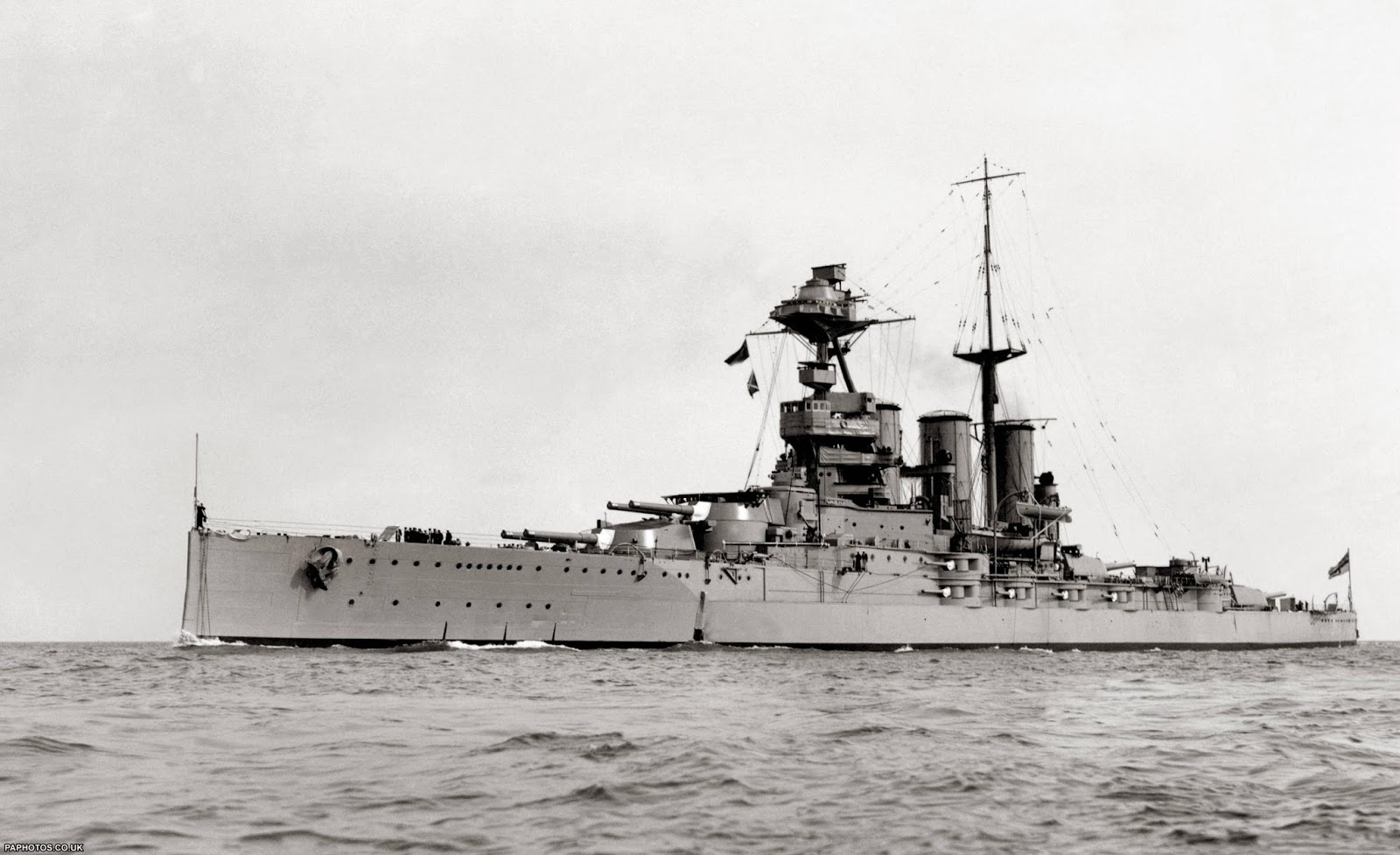
Frank spent a month ashore before being posted to his next ship HMS Barham. Frank was to serve on Barham for much of the First World War from 22nd July 1915 until September 1917. Frank was serving on board Barham during the battle of Jutland. HMS Barham was a Queen Elizabeth-class battleship of the Royal Navy named after Admiral Charles Middleton, 1st Baron Barham, built at the John Brown shipyards in Clydebank, Scotland, and launched on 31st December 1914.

HMS Barham 1917


 At the Battle of Jutland on 31 May to 1 June 1916, Barham was Admiral Hugh Evan-Thomas's flagship of the 5th Battle Squadron, attached to Admiral David Beatty's battlecruiser fleet. Barham fired 337 15-inch shells and 25 6-inch shells during the battle.The number of hits cannot be confirmed, but it is believed that she and her sister ship Valiant made 23 or 24 hits between them, making them two of the most accurate warships in the British fleet. She received six hits during the battle, five from 12-inch shells and one from an 11-inch shell, suffering casualties of 26 killed and 46 wounded.

Damage to HMS Barham inflicted at the Battle of Jutland


Following Jutland, Barham was under repair until 5 July 1916. She was refitted at Cromarty between February and March 1917, being fitted with a pair of 12-pounder anti-aircraft guns that year, and was again refitted in February 1918.

Frank was appointed Acting Sub- Lieutenant on 15th May 1917. He continued to serve on HMS Barham until September 1917 Lieutenant Commander Kennedy wrote the following comments onto his service record:

General Conduct – Satisfactory
Ability – Above Average Ability
Comments – Completed three weeks training in JBD(?) Keen interest in Engineering. Learns quickly. Highly intelligent and independent  - lacking only in physique.

A short stint on the ageing Blake Class protected cruiser HMS Blenheim was followed by a series of shore based postings during which Frank was promoted to Sub Lieutenant  and lasted until peace was declared in November 1918. Frank was to remain at HMS Alecto, a depot ship, until 15th January 1919 when he moved to the London based naval establishment President V where he studied a course regarding Naval Accounts. He then moved to HMS Conqueror for an engineering course which was to last until 20th January 1920.It was during his time on Conqueror that Frank was appointed Acting Lieutenant and then Lieutenant backdated to 15th August 1919.

An entry on Frank's service record written by a Captain Seagrove for this period states:

General Conduct – Satisfactory
Ability – Above Average Ability
Comments – A very intelligent officer with lots of character. Not very athletic but he should do well in the service if he sticks to it.


Frank remained ashore for the next 5 years until 30th January 1925 when he joined HMS Tiger which at this point had become a seagoing training ship. 

HMS Tiger


HMS Tiger was a battlecruiser built by John Brown and Company of Clydebank, Scotland, and launched in 1913. Tiger was the most heavily armoured battlecruiser of the Royal Navy at the start of the First World War, but was not yet ready for service when it began. The ship was assigned to the 1st Battlecruiser Squadron (1st BCS) for the duration of the war and participated in the Battle of Dogger Bank in early 1915, though she was still shaking down and did not perform well. Tiger next participated in the Battle of Jutland in 1916, where she was only lightly damaged despite suffering many hits by German shells. Apart from providing distant cover during the Second Battle of Heligoland Bight in 1917, she spent the rest of the war on uneventful patrols in the North Sea. Tiger was recommissioned at the end of the war as a seagoing training ship.

Frank spends much of the 1920’s and early 1930's attending courses at shore based naval establishments as well as Woolwich studying naval ordinance and in particular torpedoes. On 15th August 1927 Frank is promoted to the rank of Lieutenant Commander. By the mid 1930's he is serving on the staff at Greenwich as a Torpedo Officer.

In 1929 Frank attends the wedding of Edward Russell Gibson, 3rd Baron Ashbourne and Reta Francis Manning (nee Hazeland) Lady Ashbourne and is photographed with the wedding party wearing his uniform and First World War medals. Two years later in 1931 Frank himself married Robina Richie at St. Georges, Hanover Square in London.

Frank Schunck - Back row third from the right

 
Britain and France declared war against Nazi Germany on 3rd September 1939 whilst Frank was still serving at Greenwich as a Torpedo Officer. On 3rd October Frank was granted Acting Rank of Commander and continued to serve in the navy. 

On the 8th March 1942 Frank Schunck is placed on the Retired List with the rank of Commander (Retd)

Then on the 18th August 1942 Frank was recorded as being “on loan” to the Royal Australian Navy with the appointment of Torpedo Inspecting Officer. He and his wife, Robina, left the UK on the 21st August 1942 from Liverpool on board the SS Delftdijk a ship of the Holland America Line bound for Australia. The ship was a civilian passenger liner but was obviously doing some sort of work for the war effort as all the First Class passengers where specialist officers of the Royal Navy and their wives. The SS Delftdijk arrived in Australia on the 5th October 1942 along with Frank, Robina and several other Royal Navy specialists, engineers and liason officers.

SS Delftdijk the ship which took Frank and many Royal Navy officers to Australia in August 1942


Frank spends the remainder of the war in Australia. Once the war is over in August 1945 Frank and Robina return to the United Kingdom. On the 5th June 1946 Frank is appointed to a role serving with the Royal Navy at Woolwich. Two years later on 1st June 1948 Frank is appointed the Naval Member of The Ordinance Branch at Woolwich. On the 16th June that year he is appointed to serve in the Acting Rank of Captain at Woolwich.

Frank retires on 8th March 1956 – There is a note on his service record which states:
To be re-employed as assistant to Chief Inspector of Naval Ordinance (CINO) Group C Naval Ordinance Inspection Department in Bath. Vice Commander Busbridge – A separate communication will be made about salary.

Frank Schunck was awarded the 1914/15 Star, British War Medal and Allied Victory Medal for his service in the First World War. It is not known if Frank qualified for any medals following his service in the Second World War.

It is possible Frank Schunck died in 1974 but I do not have a definite date for him. Robina, Frank's wife, died in 1985 on Anglesey. 

The 1914/15 Star awarded to Frank Schunck Midshipman